
Agricultural Settlement
Agricultural settlement started early in the Katanning district with early settlers obtaining land from the Western Australian Land Company. They immediately started clearing land and putting in crops such as wheat, oats, and barley. Many had their own vegetable patches and many had several fruit trees.
The first industry, however, was that of the sandalwood and mallet bark cutters. Sadly, as a result, the sandalwood has been wiped out in the district.
The following story was published in the West Australian newspaper on 2nd September in 1892:
AGRICULTURAL SETTLEMENT ON
THE GREAT SOUTHERN LINE.
West Australian
2 September 1892 – P3
If rain gladdens the heart of the farmer, there must have been much joy at Katanning during my visit, for it poured unceasingly, and the community generally was in a happy and very moist condition. However, I set out with Mr. Chipper, and proceeded to drive over the country, visiting different farms.
The first farm I visited was that of a very recent settler, Mr. Alfred Hoglin, who took up his land on March 2nd, this year. My visit, to Mr. Hoglin was made in July, and in that short time I found he had completed a homestead and fencing, had 30 acres under cultivation, many more cleared, and was still hard at work. During our short chat I learned that the cost of clearing had been about £3 per acre; that this energetic settler considered the land excellent, and was perfectly satisfied with his prospects. Possibly the older settlers would growl less if they worked more.
Mr. F. T. Crosby, who has been settled here for two previous seasons, was the next farmer I met, and when I enquired as to what he thought of the capabilities of the land as compared with that of other colonies, Mr. Crosby replied that it was equal to Mount Gambier, S.A., and that he is very pleased with it. The cost of clearing this farm was £2 per acre. Water can be got anywhere by sinking, and, after ring-barking, a soak was easily obtained at nine feet.
Mr. Crosby has 94 acres under cultivation this year and told me that although the cost of cultivation is very little if any dearer than in the Eastern colonies, yet the prices obtained here are much better.
A fair average crop on this farm is 20 bushels per acre, or 26 cwt. Of hay, and during the very bad season last year the crop averaged seven bushels. Mr. Crosby has a neat house and garden, and is, as he himself puts it, quite satisfied with W.A.
Mr. Jennings is another new settler hailing from New South Wales, and has been in the colony about three years. Like all the other new settlers he was to be found at work and not in the house. Mr. Jennings only repeated what Mr. Crosby had told me as to average yield, prices, etc., but his clearing has only cost him 25s. per acre. Mr. Jennings has some 40 acres under this season, four of them being under oats, and the rest under wheat. An orchard is being cultivated here too, and at present there are 50 vines and some fruit trees planted.
I may mention that, as a rule, I made enquiries as to the terms on which the Company disposed of their land to these settlers, and whether the latter were fairly treated. The invariable reply was that the Company treated them quite fairly, and they were satisfied with both the terms and the land. It will thus be seen that as a rule new settlers are very well pleased with the country, but as a delightful change from the pessimism of some of the “old settlers.”
I can recommend your readers to interview Mr. J. H. Newton, who has been a farmer in both Victoria and South Australia and is now settled in this district. I did not need to ask many questions as Mr. Newton volunteered every information and appears to know all the country in this large district. What, I enquired do you think of the land here as compared with that of the other colonies? “Why,” replied this enthusiastic farmer, “I would sooner have one acre here than, three over there.” Mr. Newton has about 100 acres under cultivation and estimates his average crop at about 15 bushels of wheat per acre; or about one ton of hay; for barley the return is 22 bushels.
Like every other settler I interviewed, Mr. Newton remarks about the ease with which water is obtained by sinking and showed me in one paddock two springs that had broken out since the timber had been killed. Another point, too, will attract the attention of visitors to these settlements, and that is the neatness of the work, the carefully tended kitchen gardens and the fruit trees.
All, or nearly all, of these new settlers have a few sheep and pigs, and some poultry, and seem to do as much for themselves as possible.
Perhaps the most interesting farm of all I saw was that of Mr. R. S. Taylor, a farmer from Victoria, who has achieved wonders in a very short space of time. Mr. Taylor arrived in the bad season, and began his work on the 1st June last year, having taken 3000 acres of land from the Land Company. By the 1st of July Mr. Taylor had 30 acres cleared and ploughed, the clearing costing him about £2 per acre, the next 27 acres cleared costing a total of £32 only.
It is 15 months since he settled in the colony and pitched his tent, and the following record will show how Mr. Taylor and his family have worked and will make us all hope for some more settlers of his stamp. There are 150 acres under cultivation, being 90 acres of wheat, 30 acres of barley, and 30 acres of oats; 900 acres have been fenced into three paddocks, making altogether about nine miles of fencing on the property, the fence being jam posts carrying seven wires.
Twelve acres have been devoted to an orchard in which are planted 300 apple trees, chiefly export sorts, and 200 other fruit trees, including apples, quinces, peaches, pears, plums, apricots, and nectarines. All these trees have been brought from Mr. Taylor’s farm in Victoria, and he intends importing more. In addition to these fruit trees, there are 500 vines of seven different varieties, and two acres of kitchen garden, in which are growing all sorts of vegetables. It would be thought that this alone was excellent work to have accomplished in so short a time, but Mr. Taylor had still more to show me, and we walked over to inspect a large dam, out of which had been excavated about 1500 cubic yards of earth which was banked on top, thus making a tank and dam combined of great capacity.
On this farm there are 1050 sheep and, when I was there, 300 ewes had dropped 278 lambs, the lambing anticipated from the whole flock of ewes being 70 per cent. Five good cows, some pigs and poultry, and some good draught horses make up the livestock on this, the most interesting of all the farms I visited.
From so energetic and practical a man as Mr. Taylor much will be expected, and he has already strongly advised his friends to settle down in this colony. My visit to him was an enjoyable one, and I was as much struck with the excellence and neatness of his work as with the great amount of it he had accomplished.
There are many more farms in the district worthy of a visit, where one may see plenty of good farming, and any amount of industry and energy; but these few examples will suffice to prove that what I said at the outset is correct – that on the Great Southern Railway Company’s land there are some magnificent agricultural areas, and land that is equal, for wheat-growing at any rate, to anything I have ever seen, and my knowledge of the colonies is not confined to
Western Australia. If some of your readers visit this thriving district, let them pay visits to such men as Messrs. Beeck, Bauer, Holley, Geoffrey, Bell, Hamilton and others, and they can add to the information I have already given them.
A description of the agriculture round Katanning is necessarily incomplete without some reference to a “Piesse,” and I will add a few details about the orchard being laid out by Mr. F. H. Piesse. This orchard is situated close to the town and has an extent of 24 acres. At present 2300 trees are planted, of which 1200 are different varieties of apples (early and late bearing), also 230 orange and lemon trees. The orange and lemon trees arrived last year in anything but satisfactory condition, owing to bad packing but are now doing very well. Next season Mr. Piesse intends irrigating a portion of this orchard, as his well, at a depth of 70 feet is capable of supplying 6000 gallons per day.
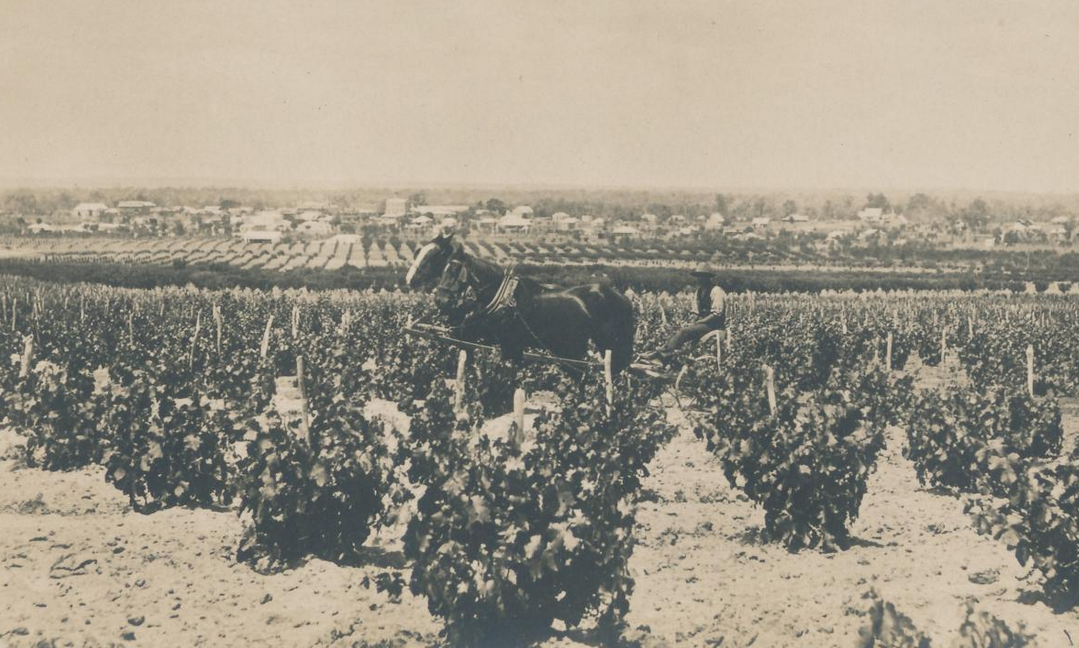
Frederick Piesse’s orchard and vineyard with Katanning in the background.
This is further evidence of the ease with which water can be obtained about here, and I will supplement it by a statement of Mr. Piesse’s, that during the last dry season the well at their mill had on many occasions 10,000 gallons per day drawn from it, often affording relief to both farmers and townspeople who had not sunk wells of their own and, in spite of this tax upon its resources, there was always a standing depth of 25ft.
I was sorry to leave Katanning and its busy people, and I owe much to the courtesy of the
Resident Magistrate, Mr. F. Piesse, M.L.A., and Mr. Harry Chipper.
Agricultural settlement. Agricultural settlement. Agricultural settlement. Agricultural settlement. Agricultural settlement.